


Openssl Generate Self Signed Certificate And Key
- Openssl Generate Self Signed Certificate And Key Download
- Openssl Generate Self Signed Certificate And Key With Passphrase
Generating self-signed certificates is an easy process. In fact, it's a one-step process. We will use SHA256 with RSA 2048 encryption. The certificate will be valid for 1 year. To generate the certificate and key, run this: openssl req -new -newkey rsa:2048 -sha256 -days 365 -nodes -x509 -keyout server.key -out server.crt. Use openssl to create an x509 self-signed certificate authority (CA), certificate signing request (CSR), and resulting private key with IP SAN and DNS SAN - create-certs.sh. May 07, 2019 This is useful so you don't have to keep track of the password and/or use a script to sign self-signed SSL certificates. Openssl rsa -in myCA.key.withpwd -out myCA.key. Convert the CA certificate from.PEM to.CRT format. Openssl x509 -outform der -in myCA.pem -out myCA.crt. You may get the following errors. Generating a self-signed certificate using OpenSSL OpenSSL is an open source implementation of the SSL and TLS protocols. It provides an encryption transport layer on top of the normal communications layer, allowing it to be intertwined with many network applications and services. Aiming to create a self-certification authority in ECDSA format, which is being adopted in the IoT. Environment CentOS7 3.10.0–957.5.1.el7.x8664 OpenSSL 1.0.2k-fips 26 Jan 2017.
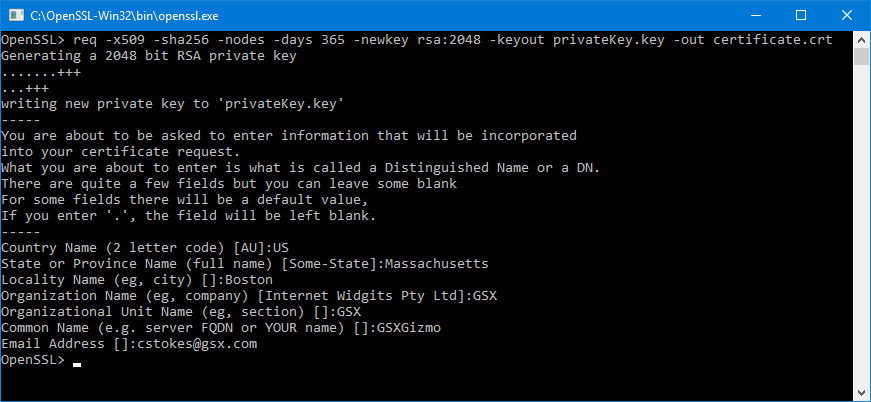
One main source of problems working with encryption is the creation of your private key and your certificate. You must create the key pair correctly, have it imported at the right place and if you just miss one important option, you can go on an endless hunt for the problem – one exception at the time.
Attention: use self-signed certificates only for testing proposes. For production, make a certificate request and get a properly signed certificate from a CA.
The certificate snap-in in mmc can create public/private key pairs. However, creating it this way means an endless list of dialog windows where you most likely miss an important setting. I tried it a few times, but whenever I needed a new certificate, I had a slightly different dialogue to work with. In my opinion, OpenSSL is a much better approach for reliable creation of certificates. The many options you have are well described in the the OpenSSL Cookbook.
Download and installation
The official site for OpenSSL lists various binary versions for Windows. The first project listed there is slproweb.com where you find the Win64 OpenSSL v1.1.1a package in the download section. The page looks old and outdated, but the binaries are frequently updated.
When the download is complete, execute the *.exe file and go through the wizard with Next.
Create your own certificate…
To create a self-signed certificate using an RSA 4096 key and the SHA256 hashing algorithm, you can run the following two commands. Be aware, you need the password you set later to import your certificate.
Openssl Generate Self Signed Certificate And Key Download
opensslreq -x509 -newkeyrsa:4096 -sha256 -keyoutmy.key -outmy.crt -subj'/CN=test.com' -days600 |
At the end, you should see your newly created certificate among all other certificates:
Access your key
To verify that the key works as expected, you can now create a console application with this code in the main method to access the build-in Windows key store:
2 4 6 8 10 12 14 16 18 20 22 24 26 | { varstore=newX509Store(StoreName.My,StoreLocation.LocalMachine); varcollection=store.Certificates.Find(X509FindType.FindBySubjectName, { Console.WriteLine($'Certificate '{myCert.FriendlyName}' is found'); Console.WriteLine($'Has private key? {myCert.HasPrivateKey}'); Console.WriteLine($'Private key: {myCert.PrivateKey.ToXmlString(true)}'); else Console.WriteLine('Certificate {0} is not found!!',name); Console.ReadKey(); |
If all works, you should get an output like this one:
If you get a CryptographicException with the message “Keyset does not exist” instead, check the permissions of the private key first. It may just need a simple fix as described here.
Conclusion
Openssl Generate Self Signed Certificate And Key With Passphrase
If you know those two OpenSSL commands, you can create as many certificates as you like. The export to pfx step is a tricky one, but as soon as you know that command as well, it is much simpler than the mmc alternative.