


Ubiquiti Generate Ssh Key For Unifi Controller
To get an SSL certificate, a Certificate Signing Request (CSR) code is required.
- Ubiquiti Generate Ssh Key For Unifi Controller Download
- Ubiquiti Networks Unifi Cloud Key
- Ubiquiti Unifi Download
- Ssh Ubiquiti Unifi
- Ubiquiti Generate Ssh Key For Unifi Controller Windows 7
Oct 24, 2019 I am trying to ssh in to the could key to make it work with our network monitoring solution. It keeps telling me that the user name and password are incorrect. Tried ubnt/ubnt and root/ubnt. Tried my admin credentials. Tried resetting the cloud key per ubiquiti's instructions.
- May 02, 2019 Setting up custom SSH keys for UniFi hardware. Create config.gateway.json to configure USG. Create config.properties to configure switch / AP / etc. Place config.gateway.json and config.properties in data/sites/default. Restart controller (maybe?) Reprovision all devices.
- Dec 29, 2018 In this video, How To Update A Unifi Device Via SSH: Part 1 Windows, I show how to update a Unifi device via SSH on the Windows platform. In the next video.
- Sep 08, 2016 This video is aimed at using SSH RSA private/public keys as an alternative to password authentication on a Ubiquiti EdgeMax device. The program used in this video is puttygen.
- Add custom SSH keys to the Ubiquiti UniFi Controller - README.md.
- You may discontinue Your use of and access to the Software at any time. Ubiquiti will automatically terminate this EULA at any time without notice to you if you fail to comply with any term of this EULA. You may terminate it at any time upon written notice to Ubiquiti at legal@ubnt.com.
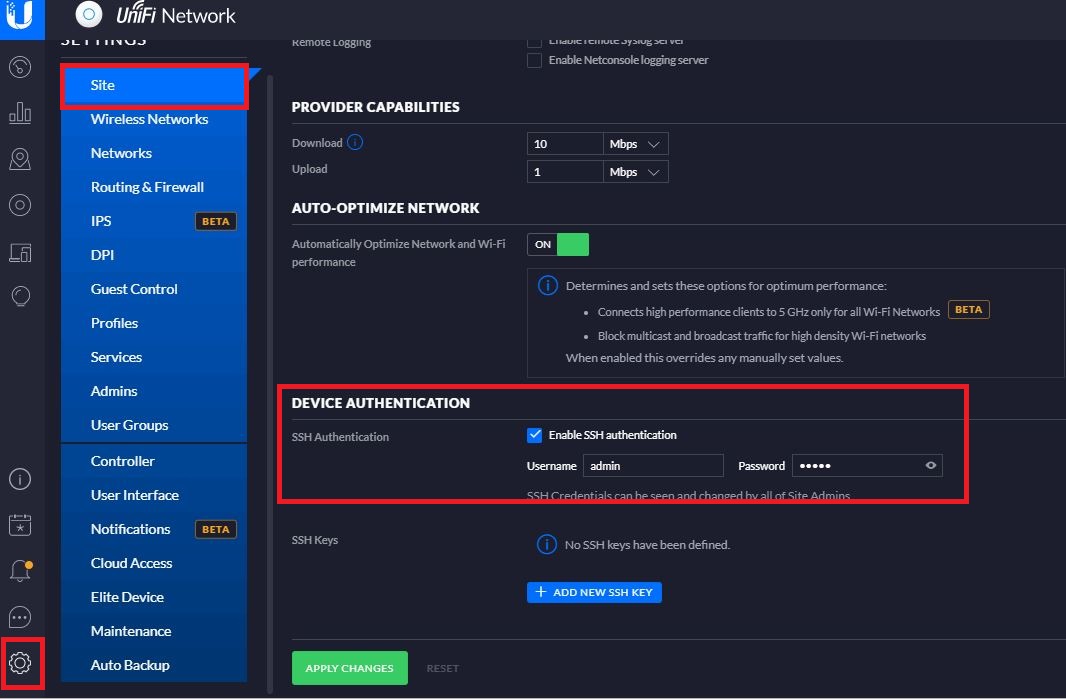
- Unifi and networking beginner here. I see that in Unifi 5.7.20 there's the new feature 'SSH keys to authenticate to device'. Inside the Unifi settings under 'Site' there's the area for the SSH username and password for device authentication, which is the user and password an adopted device gets set up with.
On UniFi controller software, a CSR code is generated along with the default UniFi keystore. Follow these steps to generate the keystore:
Step 1: First, connect to the server where the controller is installed with the help of the appropriate command prompt.
- For Linux-based servers, multiple command prompt (SSH) applications exist. The most common one is Putty. There are versions of Putty for each server type, including Linux servers and Windows servers, as well as the multiple analogues for Android.
- For MacOS, use the Terminal application.
- For Windows servers, you can connect via remote desktop and use either cmd or PowerShell.
Note: Run all further commands with administrator rights (on Windows) or under the root or sudo user (on Linux/MacOS):
- To run commands with administrator rights on a Windows server, right-click on the program icon and choose the option Run as administrator. Alternatively, you can click Properties -> Compatibility -> Mark the option ‘Run this program as an administrator’ -> confirm (OK).
- On Linux-based systems, run sudo su – to set up the required access, or you can start each command with sudo.
Step 2: Generate the CSR code, using the following command:
java -jar *UniFi root*/lib/ace.jar new_cert example.com “Company” “Location (city)” “State or province” “Country code”
(for Linux/Mac OS)
or
java -jar “*UniFi root*libace.jar” new_cert example.com “Company” “Location (city)” “State or province” “Country code”
(for Windows)
- Type your actual domain or subdomain for UniFi (the certificate common name) instead of example.com.
Use something like *.example.com for wildcard type certificate. - Company: enter your company name. If you have an Organization or Extended Validation certificate, Certificate Authorities will verify the company information supplied in the CSR code. Domain Validation SSLs don’t have company information embedded into their code. If you are using a DV certificate and don’t have a company, you can just enter N/A.
- Location (city): enter your city or locality.
- State or province: enter your state or region.
- Country: enter the appropriate 2-letter country code from this list.
- Type your actual domain or subdomain for UniFi (the certificate common name) instead of example.com.
Important:If any of the CSR values have more than one word, put them in quotation marks (“). Otherwise, the second word will be moved to the value of the next field, which may invalidate the CSR. However, it should be noted that the server will not show an error message if this happens.
Unique Key in SQL A unique key is a set of one or more than one fields/columns of a table that uniquely identify a record in a database table. You can say that it is little like primary key but it can accept only one null value and it cannot have duplicate values. Generating a unique primary key. I have a SQL Server database that will contain many tables that all connect, each with a primary key. I have a Dictionary that keeps track of the the primary keys fields are for each table. My task is to extract data every day from attribute-centric XML files and insert them into a master database. On the Table Designer menu, click Indexes/Keys. In the Indexes/Keys dialog box, click Add. In the grid under General, click Type and choose Unique Key from the drop-down list box to the right of the property. On the File menu, click Savetable name. Using Transact-SQL To create a unique constraint. In Object Explorer, connect to an instance of Database Engine. CREATE TABLE TestTable (Col1 int IDENTITY, Col2 varchar(50), Col3 int); In the following example, an open connection to the sample database is passed in to the function, an SQL statement is constructed that will add data to the table, and then the statement is run and the IDENTITY column value is displayed. 
Note: The *UniFi root* depends on the system you have UniFi controller installed on:
- /usr/lib/unifi/ (for UniFi Cloud Key, Ubuntu, and other Debian-based Linux distributions);
- /opt/unifi/ (for CentOS, RedHat, Fedora, and other RHEL Linux distributions)’;
- ~/Library/Application Support/UniFi (for Mac OS);
“%USERPROFILE%/Ubiquiti Unifi” or (which is the same) “C:Users*account username*Ubiquiti UniFi” (for Windows).
Useful tip: Alternatively, open the UniFi root folder first, using the command cd *Unifi root*, and then run the CSR generation command in it. This way you won’t need to specify the full path in the command itself.
Ubiquiti Generate Ssh Key For Unifi Controller Download
You will then receive two files: unifi_certificate.csr.pem and unifi_certificate.csr.der in the /*Unifi root*/data folder. The second file has different formatting and is not used normally.
Ubiquiti Networks Unifi Cloud Key
The text code from the unifi_certificate.csr.pem file can be used for the SSL activation.
Ubiquiti Unifi Download
Important: Instead of a Private key, UniFi creates a keystore file named keystore in /*UniFi root*/data/ (or simply *UniFi root* on some systems), to which you will only need to upload the certificate files after the issuance.
Step 3: To open the file and extract the text code, do one of the following: Call of duty 1 cd key generator download 2017.
- On Linux, you can use the command: cat /*UniFi root*/data/unifi_certificate.csr.pem
- On Mac OS, you can do the same, or go to the data subfolder -> right-click on the unifi_certificate.csr.pem file -> Open with -> choose TextEdit.
- On Windows, go to the data subfolder -> right-click on unifi_certificate.csr.pem-> Open with -> choose Notepad.
- Alternatively, you can just use the command:
notepad “*UniFi root*/data/unifi_certificate.csr.pem”
Ssh Ubiquiti Unifi
Footnotes:
Ubiquiti Generate Ssh Key For Unifi Controller Windows 7
If you use the option “Auto-activate” during the SSL activation, this whole process can be skipped. However, it will require a specific installation process.
As a general rule, for UniFi on Windows the “Auto-activate” option may be more convenient, while in other cases it is easier to use the CSR created on UniFi.