


Generate Asymmetric Key Pair C
Generating Public/Private Keys In C# And.NET. How to generate public/private key in C#. Asymmetric cryptography also known as public-key encryption uses a public/private key pair to encrypt and decrypt data. In.NET, the RSACryptoServiceProvider and DSACryptoServiceProvider classes are used for asymmetric encryption.
- Oct 12, 2016 Angela from the API support team walks through how to generate a public private key pair using OpenSSL and register a private application. If you want to try integrating to Xero, partner with us.
- Mar 03, 2020 This page explains how to generate public/private key pairs using OpenSSL command-line tools. Device authentication. Cloud IoT Core uses public key (or asymmetric) authentication: The device uses a private key to sign a JSON Web Token (JWT). The token is passed to Cloud IoT Core as proof of the device's identity.
This walkthrough demonstrates how to encrypt and decrypt content. The code examples are designed for a Windows Forms application. This application does not demonstrate real world scenarios, such as using smart cards. Instead, it demonstrates the fundamentals of encryption and decryption.
This walkthrough uses the following guidelines for encryption:
Use the RijndaelManaged class, a symmetric algorithm, to encrypt and decrypt data by using its automatically generated Key and IV.
Use the RSACryptoServiceProvider, an asymmetric algorithm, to encrypt and decrypt the key to the data encrypted by RijndaelManaged. Asymmetric algorithms are best used for smaller amounts of data, such as a key.
Note
If you want to protect data on your computer instead of exchanging encrypted content with other people, consider using the ProtectedData or ProtectedMemory classes.
The following table summarizes the cryptographic tasks in this topic.
| Task | Description |
|---|---|
| Creating a Windows Forms application | Lists the controls that are required to run the application. |
| Declaring global objects | Declares string path variables, the CspParameters, and the RSACryptoServiceProvider to have global context of the Form class. |
| Creating an asymmetric key | Creates an asymmetric public and private key value pair and assigns it a key container name. |
| Encrypting a file | Displays a dialog box to select a file for encryption and encrypts the file. |
| Decrypting a file | Displays a dialog box to select an encrypted file for decryption and decrypts the file. |
| Getting a private key | Gets the full key pair using the key container name. |
| Exporting a public key | Saves the key to an XML file with only public parameters. |
| Importing a public key | Loads the key from an XML file into the key container. |
| Testing the application | Lists procedures for testing this application. |
Prerequisites
You need the following components to complete this walkthrough:
- References to the System.IO and System.Security.Cryptography namespaces.
Creating a Windows Forms Application
Most of the code examples in this walkthrough are designed to be event handlers for button controls. The following table lists the controls required for the sample application and their required names to match the code examples.
| Control | Name | Text property (as needed) |
|---|---|---|
| Button | buttonEncryptFile | Encrypt File |
| Button | buttonDecryptFile | Decrypt File |
| Button | buttonCreateAsmKeys | Create Keys |
| Button | buttonExportPublicKey | Export Public Key |
| Button | buttonImportPublicKey | Import Public Key |
| Button | buttonGetPrivateKey | Get Private Key |
| Label | label1 | Key not set |
| OpenFileDialog | openFileDialog1 | |
| OpenFileDialog | openFileDialog2 |
Double-click the buttons in the Visual Studio designer to create their event handlers.
Declaring Global Objects
Add the following code to the Form's constructor. Edit the string variables for your environment and preferences.
Creating an Asymmetric Key
This task creates an asymmetric key that encrypts and decrypts the RijndaelManaged key. This key was used to encrypt the content and it displays the key container name on the label control.
Windows 7 pro key generator online. Windows 7 Professional 32 bit Online Product key is utilized as a Pro form Business Developers to Activate Windows 7 Professional OS. Mar 09, 2020 Overview of Windows 7 Product Key Generator. Windows 7 is a generally accepted Windows worldwide. It is now widely considered as the Windows OS with the friendliest interface. This makes people have an interest in getting it installed on their laptop. Various kinds of people use it, both for personal works and for business-oriented programs. Nov 24, 2019 Sere is a list of Windows 7 Key 76 Sit and Windows 7 Product Key duct key 32 Sit that you can look forward to it. These are universal product keys that will work for SotS the versions. More Download: Windows 10 Activator Free Download With Key 2020 (32/64 Bit).
Add the following code as the Click event handler for the Create Keys button (buttonCreateAsmKeys_Click).
Encrypting a File
This task involves two methods: the event handler method for the Encrypt File button (buttonEncryptFile_Click) and the EncryptFile method. The first method displays a dialog box for selecting a file and passes the file name to the second method, which performs the encryption.
The encrypted content, key, and IV are all saved to one FileStream, which is referred to as the encryption package.
The EncryptFile method does the following:
Creates a RijndaelManaged symmetric algorithm to encrypt the content.
Creates an RSACryptoServiceProvider object to encrypt the RijndaelManaged key.
Uses a CryptoStream object to read and encrypt the FileStream of the source file, in blocks of bytes, into a destination FileStream object for the encrypted file.
Determines the lengths of the encrypted key and IV, and creates byte arrays of their length values.
Writes the Key, IV, and their length values to the encrypted package.
The encryption package uses the following format:
Key length, bytes 0 - 3
IV length, bytes 4 - 7
Encrypted key
IV
Cipher text
You can use the lengths of the key and IV to determine the starting points and lengths of all parts of the encryption package, which can then be used to decrypt the file.
Add the following code as the Click event handler for the Encrypt File button (buttonEncryptFile_Click).
Add the following EncryptFile method to the form.
Decrypting a File
This task involves two methods, the event handler method for the Decrypt File button (buttonDecryptFile_Click), and the DecryptFile method. The first method displays a dialog box for selecting a file and passes its file name to the second method, which performs the decryption.
Generate Asymmetric Key Pair C Example
The Decrypt method does the following:
Creates a RijndaelManaged symmetric algorithm to decrypt the content.
Reads the first eight bytes of the FileStream of the encrypted package into byte arrays to obtain the lengths of the encrypted key and the IV.
Extracts the key and IV from the encryption package into byte arrays.
Creates an RSACryptoServiceProvider object to decrypt the RijndaelManaged key.
Uses a CryptoStream object to read and decrypt the cipher text section of the FileStream encryption package, in blocks of bytes, into the FileStream object for the decrypted file. When this is finished, the decryption is completed.
Add the following code as the Click event handler for the Decrypt File button.
Add the following DecryptFile method to the form.
Exporting a Public Key
This task saves the key created by the Create Keys button to a file. It exports only the public parameters.
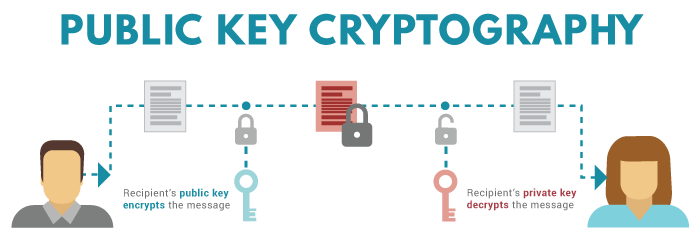
This task simulates the scenario of Alice giving Bob her public key so that he can encrypt files for her. He and others who have that public key will not be able to decrypt them because they do not have the full key pair with private parameters.
Add the following code as the Click event handler for the Export Public Key button (buttonExportPublicKey_Click).
Importing a Public Key
This task loads the key with only public parameters, as created by the Export Public Key button, and sets it as the key container name.
This task simulates the scenario of Bob loading Alice's key with only public parameters so he can encrypt files for her.
Add the following code as the Click event handler for the Import Public Key button (buttonImportPublicKey_Click).
Getting a Private Key
This task sets the key container name to the name of the key created by using the Create Keys button. The key container will contain the full key pair with private parameters.
This task simulates the scenario of Alice using her private key to decrypt files encrypted by Bob.
Add the following code as the Click event handler for the Get Private Key button (buttonGetPrivateKey_Click).
Testing the Application
After you have built the application, perform the following testing scenarios.
Asymmetric Key Algorithm
To create keys, encrypt, and decrypt
Click the
Create Keysbutton. The label displays the key name and shows that it is a full key pair.Click the
Export Public Keybutton. Note that exporting the public key parameters does not change the current key.Click the
Encrypt Filebutton and select a file.Click the
Decrypt Filebutton and select the file just encrypted.Examine the file just decrypted.
Close the application and restart it to test retrieving persisted key containers in the next scenario.
To encrypt using the public key
Click the
Import Public Keybutton. The label displays the key name and shows that it is public only.Click the
Encrypt Filebutton and select a file.Click the
Decrypt Filebutton and select the file just encrypted. This will fail because you must have the private key to decrypt.
This scenario demonstrates having only the public key to encrypt a file for another person. Typically that person would give you only the public key and withhold the private key for decryption.
To decrypt using the private key
Click the
Get Private Keybutton. The label displays the key name and shows whether it is the full key pair.Click the
Decrypt Filebutton and select the file just encrypted. This will be successful because you have the full key pair to decrypt.
See also
Cryptography
Derrick Rountree, in Security for Microsoft Windows System Administrators, 2011
Asymmetric Encryption
Asymmetric encryption is also referred to as public key encryption. In asymmetric encryption, both the encrypting and decrypting systems have a set of keys. One is called the public key, and another is called the private key. If the message is encrypted with one key in the pair, the message can be decrypted only with the other key in the pair.
Asymmetric key algorithms are not quite as fast as symmetric key algorithms. This is partially due to the fact that asymmetric key algorithms are generally more complex, using a more sophisticated set of functions.
Asymmetric Key Algorithms
Asymmetric key algorithms aren't as widely used as their symmetric counterparts. So we'll just go over two of the big ones: Diffie-Hellman and RSA.
Diffie-Hellman: The Diffie-Hellman algorithm was one of the earliest known asymmetric key implementations. The Diffie-Hellman algorithm is mostly used for key exchange. Although symmetric key algorithms are fast and secure, key exchange is always a problem. You have to figure out a way to get the private key to all systems. The Diffie-Hellman algorithm helps with this. The Diffie-Hellman algorithm will be used to establish a secure communication channel. This channel is used by the systems to exchange a private key. This private key is then used to do symmetric encryption between the two systems.
RSA: It is the Rivest Shamir Adelman algorithm. RSA was developed in 1978. RSA was the first widely used asymmetric algorithms used for signing and encryption. It supports key lengths of 768 and 1,024 bits. The RSA algorithm uses a three-part process. The first part is key generation. The keys used in the RSA algorithm are generated using mathematical operations based on prime numbers. The second part of the process is encryption. This encryption is done using one of the keys in the key pair. The third part of the process is decryption. The decryption is done using the other key in the key pair.
Read full chapter