


C Generate An Api Key
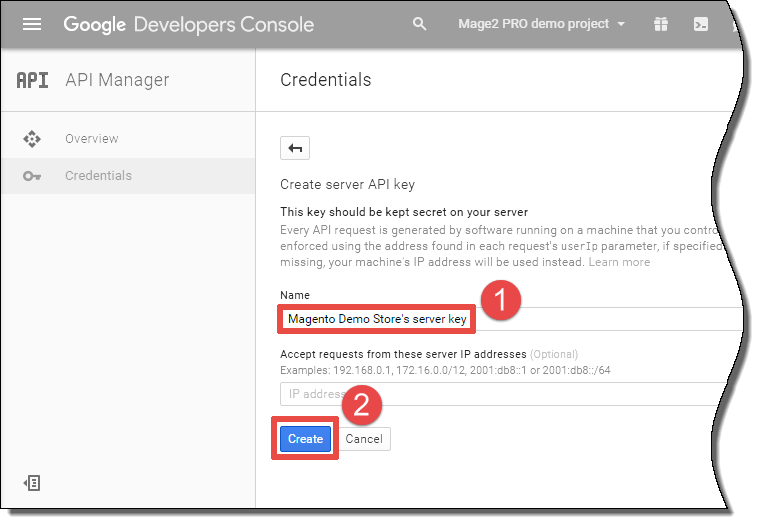
The above code will generate an API key value base on your provided password and secret/salt key values. If you have purchased the license key of this library then you can provide your license key in the last parameter, i.e. To create your application's API key: Go to the API Console. From the projects list, select a project or create a new one. If the APIs & services page isn't already open, open the left side menu and select APIs & services. On the left, choose Credentials. Click Create credentials and then.
- C Generate An Api Key In Windows 10
- C Generate An Api Key Login
- C Generate An Api Key In Excel
- C Generate An Api Key Free
by Ramesh Lingappa
We all know how valuable APIs are. They’re the gateway to exploring other services, integrating with them, and building great solutions faster.
You might have built or are thinking of building APIs for other developers to use. An API needs some form of authentication to provide authorised access to the data it returns.
There are several authentication standards available today such as API Keys, OAuth, JWT, etc.
In this article, we’ll look at how to correctly manage API Keys to access APIs.
So Why API Keys?

API Keys are simple to use, they’re short, static, and don’t expire unless revoked. They provide an easy way for multiple services to communicate.
If you provide an API for your clients to consume, it’s essential for you to build it in the right way.
Let’s get started, and I’ll show you how to build API Keys the right way.
API Key Generation
Since the API key itself is an identity by which to identify the application or the user, it needs to be unique, random and non-guessable. API keys that are generated must also use Alphanumeric and special characters. An example of such an API key is zaCELgL.0imfnc8mVLWwsAawjYr4Rx-Af50DDqtlx.
Secure API Key Storage
Since the API key provides direct access to data, it’s pretty much like a password that a user of a web or mobile app provides to gain access to the same data.
Think about it. The reason we need to store API keys is to make sure that the API key in the request is valid and issued by us (just like a password).
We don’t need to know the raw API key, but just need to validate that the key is correct. So instead of storing the key in plain text (bad) or encrypting it, we should store it as a hashed value within our database.
A hashed value means that even if someone gains unauthorised access to our database, no API keys are leaked and it’s all safe. The end user would send the raw API key in each API request, and we can validate it by hashing the API key in the request and compare the hashed key with the hash stored within our database. Here is a rough implementation of it in Java:
In the code above, the primary key will be a combination of the prefix and the hash of the API key {prefix}.{hash_of_whole_api_key}.
But hold on, there is more. Storing a hashed value brings specific usability problems. Let’s address those now.
Presenting the API Key to users
Since we don’t store the original API key, we can show it only once to the user, at the time of creation. So be sure to alert users that it cannot be retrieved again, and they need to generate a new token if they forget to copy the API key and store it safely. You can do something like this:
How users can identify a generated API Key later
Another problem is how users identify the right API key in your console if they need to edit or revoke it. This can be solved by adding a prefix to the API key. Notice in the picture above the first 7 characters (that’s our prefix), separated by the dot.
Now you can store this prefix in the database and display it in the console so users are able to quickly identify the right API key entry, like this:
Don’t give the API Key all the power
One common mistake that API key providers make is providing one key to access everything, since it’s easy to manage. Don’t do that. Assume that a user just needs to read an email, and generates an API key. But that key now has full access to other services, including deleting records in the database.
The right approach is to allow the end users to properly restrict API Key access and choose specific actions that an API key can carry out. This can be done by providing scopes, where each scope represents a specific permission.
For example,
- if you need an API key to just send emails, you can generate an API key with the scope as “email.send”
- if the end user has multiple servers and each carries out a specific action, then a separate API key can be generated with a specific scope.
So while creating the API key, allow users to select what access that API key should have, as in the image below.
This way users can generate multiple API keys, each with specific rules of access for better security. And when an API request is received, you can check if the API Key has the right scope to access that API. Now the database looks something like this:
Rate limiting API keys
Yes, you might already know it, but it is important to rate limit requests made with specific API Keys to ensure no bad actor can take down your API servers or cause performance issues that affect your other customers. Having a proper rate limiting and monitoring solution keeps the API service healthy.
Conclusion
API keys, when built right, are still a great way to communicate with another server. As we reviewed in this article, following certain practices offers benefits to both API consumers and API providers. Hope this helps you.
Happy Securing your APIs!
-->C Generate An Api Key In Windows 10
phKey. This handle can then be used as needed with any CryptoAPI function that requires a key handle.The calling application must specify the algorithm when calling this function. Because this algorithm type is kept bundled with the key, the application does not need to specify the algorithm later when the actual cryptographic operations are performed.
Dll files fixer license key _generator_v.1.6 key. DLL files fixer license key + crack Scan the registry files that control your computer performance and fix them automatically. Dll files license key free. Skip to primary navigation. DLL Files Fixer 2019 is the stable version to download free. It for Windows XP, Vista, 7, 8, 8.1, 10 operating system 32bit-64bit. DLL Files Fixer Crack has a proper database system; Only prefer these files that have real source and MD5 Identifier. It works on MD5 Identifier to boost the systems.
Syntax
Parameters
hProv
A handle to a cryptographic service provider (CSP) created by a call toCryptAcquireContext.
Algid
AnALG_ID value that identifies the algorithm for which the key is to be generated. Values for this parameter vary depending on the CSP used.
For ALG_ID values to use with the Microsoft Base Cryptographic Provider, seeBase Provider Algorithms.
For ALG_ID values to use with the Microsoft Strong Cryptographic Provider or the Microsoft Enhanced Cryptographic Provider, seeEnhanced Provider Algorithms.
For a Diffie-Hellman CSP, use one of the following values.
| Value | Meaning |
|---|---|
| Specifies an 'Ephemeral' Diffie-Hellman key. |
| Specifies a 'Store and Forward' Diffie-Hellman key. |
In addition to generating session keys for symmetric algorithms, this function can also generate public/private key pairs. Each CryptoAPI client generally possesses two public/private key pairs. To generate one of these key pairs, set the Algid parameter to one of the following values.
| Value | Meaning |
|---|---|
| Key exchange |
| Digital signature |
dwFlags
PuTTYgen is an key generator tool for creating SSH keys for PuTTY. It is analogous to the ssh-keygen tool used in some other SSH implementations. The basic function is to create public and private key. Generating SSH keys. If you don’t have a SSH public/private key pair you can generate it using the puttygen utility. From now on I’ll use%USERHOME% whenever I refer to your Windows user home folder, which depending on your Windows version may be located in. If you have GitHub Desktop installed, you can use it to clone repositories and not deal with SSH keys. It also comes with the Git Bash tool, which is the preferred way of running git commands on Windows. Ensure the ssh-agent is running: If you are using the Git Shell that's installed with GitHub Desktop, the ssh-agent should be running. Sep 26, 2019 Generating an SSH key. To generate an SSH key with PuTTYgen, follow these steps: Open the PuTTYgen program. For Type of key to generate, select SSH-2 RSA.; Click the Generate button.; Move your mouse in the area below the progress bar. Create and add your SSH key pair. It is best practice to use Git over SSH instead of Git over HTTP. In order to use SSH, you will need to: Create an SSH key pair; Add your SSH public key to GitLab. Creating your SSH key pair. Go to your command line. Follow the instructions to generate your SSH key pair. Generate ssh public key puttygen.
Specifies the type of key generated. The sizes of a session key, RSA signature key, and RSA key exchange keys can be set when the key is generated. The key size, representing the length of the key modulus in bits, is set with the upper 16 bits of this parameter. Thus, if a 2,048-bit RSA signature key is to be generated, the value 0x08000000 is combined with any other dwFlags predefined value with a bitwise-OR operation. The upper 16 bits of 0x08000000 is 0x0800, or decimal 2,048. The RSA1024BIT_KEY value can be used to specify a 1024-bit RSA key.
Due to changing export control restrictions, the default CSP and default key length may change between operating system versions. It is important that both the encryption and decryption use the same CSP and that the key length be explicitly set using the dwFlags parameter to ensure interoperability on different operating system platforms.
In particular, the default RSA Full Cryptographic Service Provider is the Microsoft RSA Strong Cryptographic Provider. The default DSS Signature Diffie-Hellman Cryptographic Service Provider is the Microsoft Enhanced DSS Diffie-Hellman Cryptographic Provider. Each of these CSPs has a default 128-bit symmetric key length for RC2 and RC4 and a 1,024-bit default key length for public key algorithms.
If the upper 16 bits is zero, the default key size is generated. If a key larger than the maximum or smaller than the minimum is specified, the call fails with the ERROR_INVALID_PARAMETER code.
The following table lists minimum, default, and maximum signature and exchange key lengths beginning with Windows XP.
| Key type and provider | Minimum length | Default length | Maximum length |
|---|---|---|---|
| RSA Base Provider Signature and ExchangeKeys | 384 | 512 | 16,384 |
| RSA Strong and Enhanced Providers Signature and Exchange Keys | 384 | 1,024 | 16,384 |
| DSS Base Providers Signature Keys | 512 | 1,024 | 1,024 |
| DSS Base Providers Exchange Keys | Not applicable | Not applicable | Not applicable |
| DSS/DH Base Providers Signature Keys | 512 | 1,024 | 1,024 |
| DSS/DH Base Providers Exchange Keys | 512 | 512 | 1,024 |
| DSS/DH Enhanced Providers Signature Keys | 512 | 1,024 | 1,024 |
| DSS/DH Enhanced Providers Exchange Keys | 512 | 1,024 | 4,096 |
For session key lengths, see CryptDeriveKey.
For more information about keys generated using Microsoft providers, seeMicrosoft Cryptographic Service Providers.
The lower 16-bits of this parameter can be zero or a combination of one or more of the following values.
| Value | Meaning |
|---|---|
| If this flag is set, the key can be exported until its handle is closed by a call to CryptDestroyKey. This allows newly generated keys to be exported upon creation for archiving or key recovery. After the handle is closed, the key is no longer exportable. |
| This flag is not used. |
| If this flag is set, then the key is assigned a random salt value automatically. You can retrieve this salt value by using the CryptGetKeyParam function with the dwParam parameter set to KP_SALT. If this flag is not set, then the key is given a salt value of zero. When keys with nonzero salt values are exported (throughCryptExportKey), then the salt value must also be obtained and kept with the key BLOB. |
| This flag is not used. |
| If this flag is set, then the key can be transferred out of the CSP into a key BLOB by using the CryptExportKey function. Because session keys generally must be exportable, this flag should usually be set when they are created. If this flag is not set, then the key is not exportable. For a session key, this means that the key is available only within the current session and only the application that created it will be able to use it. For a public/private key pair, this means that the private key cannot be transported or backed up. This flag applies only to session key and private key BLOBs. It does not apply to public keys, which are always exportable. |
| This flag specifies strong key protection. When this flag is set, the user is prompted to enter a password for the key when the key is created. The user will be prompted to enter the password whenever this key is used. This flag is only used by the CSPs that are provided by Microsoft. Third party CSPs will define their own behavior for strong key protection. Specifying this flag causes the same result as calling this function with the CRYPT_USER_PROTECTED flag when strong key protection is specified in the system registry. If this flag is specified and the provider handle in the hProv parameter was created by using the CRYPT_VERIFYCONTEXT or CRYPT_SILENT flag, this function will set the last error to NTE_SILENT_CONTEXT and return zero. Windows Server 2003 and Windows XP: This flag is not supported. |
| This flag is not used. |
| This flag is not used. |
| This flag specifies that a no salt value gets allocated for a forty-bit symmetric key. For more information, see Salt Value Functionality. |
| This flag is not used. |
| This flag specifies an initial Diffie-Hellman or DSS key generation. This flag is useful only with Diffie-Hellman and DSS CSPs. When used, a default key length will be used unless a key length is specified in the upper 16 bits of the dwFlags parameter. If parameters that involve key lengths are set on a PREGEN Diffie-Hellman or DSS key using CryptSetKeyParam, the key lengths must be compatible with the key length set here. |
| This flag is not used. |
| This flag is not used. |
| This flag is not used. |
| If this flag is set, the user is notified through a dialog box or another method when certain actions are attempting to use this key. The precise behavior is specified by the CSP being used. If the provider context was opened with the CRYPT_SILENT flag set, using this flag causes a failure and the last error is set to NTE_SILENT_CONTEXT. |
| This flag is not used. |
phKey
Address to which the function copies the handle of the newly generated key. When you have finished using the key, delete the handle to the key by calling the CryptDestroyKey function.
Return value
C Generate An Api Key Login
Returns nonzero if successful or zero otherwise.
For extended error information, callGetLastError.
The error codes prefaced by 'NTE' are generated by the particular CSP being used. Some possible error codes are listed in the following table.
| Return code | Description |
|---|---|
| One of the parameters specifies a handle that is not valid. |
| One of the parameters contains a value that is not valid. This is most often a pointer that is not valid. |
| The Algid parameter specifies an algorithm that this CSP does not support. |
| The dwFlags parameter contains a value that is not valid. |
| The hProv parameter does not contain a valid context handle. |
| The function failed in some unexpected way. |
| The provider could not perform the action because the context was acquired as silent. |
Remarks
If keys are generated for symmetricblock ciphers, the key, by default, is set up in cipher block chaining (CBC) mode with an initialization vector of zero. This cipher mode provides a good default method for bulk encrypting data. To change these parameters, use theCryptSetKeyParam function.
To choose an appropriate key length, the following methods are recommended:
- Enumerate the algorithms that the CSP supports and get maximum and minimum key lengths for each algorithm. To do this, call CryptGetProvParam with PP_ENUMALGS_EX.
- Use the minimum and maximum lengths to choose an appropriate key length. It is not always advisable to choose the maximum length because this can lead to performance issues.
- After the desired key length has been chosen, use the upper 16 bits of the dwFlags parameter to specify the key length.
Examples
The following example shows the creation of a random session key. For an example that includes the complete context for this example, see Example C Program: Encrypting a File. For another example that uses this function, see Example C Program: Decrypting a File.
C Generate An Api Key In Excel
Requirements
| Minimum supported client | Windows XP [desktop apps only] |
| Minimum supported server | Windows Server 2003 [desktop apps only] |
| Target Platform | Windows |
| Header | wincrypt.h |
| Library | Advapi32.lib |
| DLL | Advapi32.dll |